
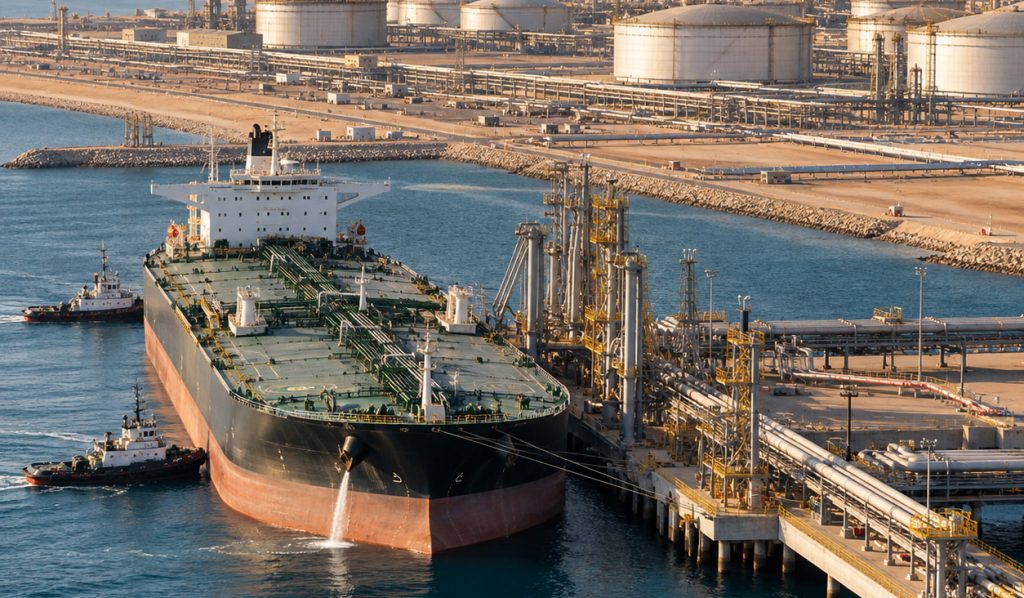

According to WPB, Saudi Arabia has resumed crude-oil loadings from the Red Sea port of Yanbu after partial repairs to the damaged East–West Pipeline, marking a significant operational step beyond the pipeline restart reported earlier in September. The system is now moving around 3.5 million barrels per day, restoring a major export route that allows Saudi crude to reach the Red Sea without passing through the Strait of Hormuz.
The distinction between pipeline restart and export restart is important. Saudi Arabia began pumping oil through the East–West system earlier in the month after repairs and pressure testing, but crude was initially directed toward storage and Red Sea refineries while sufficient volumes were accumulated at Yanbu. As of September 24, crude tanker loading had still not resumed despite several vessels being scheduled to call at the terminal. The start of actual vessel loading over the following weekend therefore represents a new and measurable stage of the recovery.
Only a limited number of tankers were initially loading at Yanbu, indicating that operations remain in a partial recovery phase. The approximately 3.5 million bpd pipeline throughput should also not be interpreted as 3.5 million bpd of exports from Yanbu because part of the crude moving west is being supplied to domestic refineries along the Red Sea coast. The precise export volume will depend on how much crude is retained for domestic processing, terminal inventories and the pace at which tanker loading increases.
The current throughput nevertheless represents a substantial recovery from the low-rate restart seen immediately after the pipeline returned to operation. Before the latest disruption, Saudi Arabia had been using the East–West system to reroute roughly 4 million bpd of crude away from Hormuz, while the pipeline itself has a maximum capacity of around 7 million bpd. The present 3.5 million bpd rate therefore restores a large share of the route’s recent operational role, although it remains well below maximum design capacity.
The pipeline was shut after drone attacks damaged three of its pumping stations in mid-September and brought crude loadings at Yanbu to a halt. The outage removed Saudi Arabia’s most important physical bypass to Hormuz at a time when shipping through the Strait was already constrained, forcing the kingdom to redirect much larger volumes toward Gulf terminals and rely more heavily on tanker movements through Hormuz and ship-to-ship transfers off Oman.
That rerouting changed the regional tanker market within days. Saudi crude flows through Hormuz rose sharply during September, while more than 60 million barrels were marketed for transfer off Sohar during September and October. The increase added Saudi volumes to an STS system already handling crude from Iraq, the UAE and other producers, eventually pushing Gulf of Oman transfer activity toward its practical operating limits.
The consequences were visible in both vessel availability and freight. STS cycles that previously required around five to seven days stretched toward 10 days as queues developed for transfer windows, tugboats, personnel and equipment. The daily equivalent earnings for VLCCs carrying Middle Eastern crude toward China climbed to around $1.27 million at the peak of the squeeze, demonstrating how quickly an infrastructure disruption on land translated into higher maritime costs.
The resumption of Yanbu exports therefore matters not only because Saudi Arabia has recovered another outlet for its crude but because it could begin reversing some of the exceptional pressure created elsewhere in the logistics system. Every barrel sent west through the East–West Pipeline rather than east toward Gulf terminals reduces the amount of Saudi crude that potentially needs to pass through Hormuz and use the congested transfer network off Oman.
At 3.5 million bpd, the theoretical scale of that relief is substantial, although the actual effect will depend on how much pipeline crude is exported rather than processed domestically and how quickly Yanbu loading activity expands. If tanker departures from Yanbu continue to increase, Saudi requirements for Gulf shuttle operations and Oman STS capacity could begin to decline from the extraordinary levels seen during the second half of September.